IFR Training in Indiana
Cities in Indiana with Aviation Schools:
- Anderson
- Avon
- Bloomington
- Brownsburg
- Carmel
- Clarksville
- Columbus
- Crown Point
- East Chicago
- Elkhart
- Evansville
- Fishers
- Fort Wayne
- Franklin
- Gary
- Goshen
- Granger
- Greenfield
- Greenwood
- Hammond
- Highland
- Hobart
- Indianapolis
- Jeffersonville
- Kokomo
- La Porte
- Lafayette
- Lawrence
- Logansport
- Marion
- Merrillville
- Michigan City
- Mishawaka
- Muncie
- Munster
- New Albany
- Noblesville
- Plainfield
- Portage
- Richmond
- Schererville
- Seymour
- Shelbyville
- South Bend
- St John
- Terre Haute
- Valparaiso
- West Lafayette
- Westfield
- Zionsville
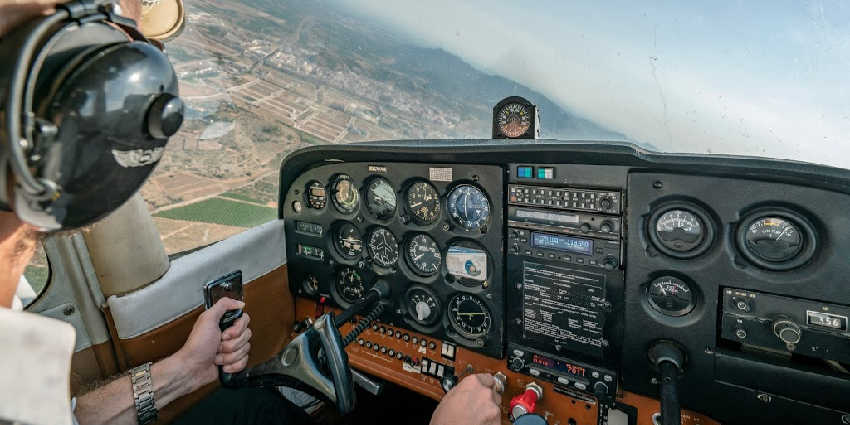
Instrument Rating Flight Training Indiana
The instrument rating (IFR) is something that will eventually come along if you've been flying very long. Typically, it comes up when looking at buying an aircraft or seeking a commercial pilot career, but otherwise, some pilots may take quite a while to get their instrument rating in Indiana. Though many pilots in Indiana do eventually get an instrument rating, chances are learning to fly IFR in Indiana now could greatly benefit your future flying.
An instrument rating will make you a better pilot, is required to get a commercial pilot certificate, and will generally lower your insurance rates. Flying on instruments in Indiana will make you a better pilot. When it comes to flying on instruments, precision is the keyword. There are many different things to learn for your instrument rating, but none are more difficult and rewarding as learning to fly with precision.
Once you complete your instrument rating in Indiana, you will be able to not only hit a specific altitude or descent rate but hold it. You will be more in control of your aircraft than you ever thought possible and this will surely affect your flying in general.
Perhaps you're not thinking about it right this moment, but at some point in the future, you may decide to get a commercial pilot certificate. That doesn't mean you have to run off to the airlines. There are many commercial pilots that never really get paid to fly, but it is nice to have the option.
Commercial Pilots in Indiana Need an Instrument Rating to Get a Job
Maybe your company has a nice aircraft that you'd like to spend some time in or you'd occasionally like to take on a paying passenger--whatever the case, although it's not required, you're going to want an instrument rating to go along with your commercial pilot certificate.
If you wait until then to get instrument rated, you're going to have a lot of training to do. Instead, reap the benefits of learning precise flying early and you can sail through commercial pilot training when you need it.
Do You Want to Earn Your Instrument Rating IFR in Indiana?
Insurance rates are generally cheaper for instrument-rated pilots. Perhaps the poorest-kept secret of the aviation insurance industry is that instrument-rated pilots enjoy rates that are generally cheaper. The increased training instrument-rated pilots take on and their increased skill pay off in lower insurance premiums. Depending on the type of aircraft you fly, this can be a very significant amount of money.
So, if you'd like to be a better pilot with lower insurance rates and you might get a commercial pilot certificate, you should definitely consider an instrument rating. Sure it may be difficult, but the sense of accomplishment and precision flying skill is more than worth it in the long run.
Legend has it that the instrument rating in Indiana is the most difficult to earn of all licenses, ratings, and endorsements. And if you talk to an instrument-rated pilot, he or she will probably agree. However, the instrument rating could also be the most rewarding of all to earn, and the benefits and privileges of acquiring the rating are well worth the initial effort.
Simply stated, the instrument rating allows pilots to fly under instrument flight rules (IFR) in Indiana, in instrument meteorological conditions (IMC), and in class A airspace (the airspace between 18,000 feet msl and 60,000 feet msl). IMC is loosely defined as conditions that do not meet the basic requirements of operating under visual flight rules (VFR), including ceilings less than 1000 feet above airport elevation and/or visibility less than 3 miles at the airport.
Although the instrument rating gives pilots permission to operate in less than basic VFR conditions, it's not a "license" to fly in bad weather. Prudent pilots do not launch into deadly weather just because they are instrument rated. Learn about instrument rating training.
FAA - A History of Airplane Structures Facts for Indiana
The work of all of these men was known to the Wright Brothers when they built their successful, powered airplane in 1903. The first of its kind to carry a man aloft, the Wright Flyer had thin, cloth-covered wings attached to what was primarily truss structures made of wood. The wings contained forward and rear spars and were supported with both struts and wires. Stacked wings (two sets) were also part of the Wright Flyer.
Helicopter Main Rotor System
The rotor system is the rotating part of a helicopter which generates lift. The rotor consists of a mast, hub, and rotor blades. The mast is a cylindrical metal shaft that extends upwards from and is driven, and sometimes supported, by the transmission. At the top of the mast is the attachment point for the rotor blades called the hub. The rotor blades are then attached to the hub by any number of different methods. Main rotor systems are classified according to how the main rotor blades are attached and move relative to the main rotor hub. There are three basic classifications: rigid, semirigid, or fully articulated.
IFR Instrument Rating Training in Indiana
Depending on your flight training goals, instrument rating training may be required, but it is a good idea regardless of your goals. There are many places to learn to fly on instruments, so what should you look for when trying to find a school? There are three basic questions that should guide you to a good choice.
What kind of aircraft are available and, after I get my instrument rating, can I rent airplanes for actual IFR flights? Most flight schools offer at least one aircraft that is certified for IFR flight. Some even have several. The question is, do they offer the kind of aircraft you need?
Are you looking for training in a new glass panel or round gauges or both? Your personal preference and goals should be considered before choosing a school. A final consideration, assuming you don't own your own aircraft, is whether the school will rent you an aircraft after you get your rating for flight into actual IMC. This is important because you will want to maintain currency and there is no substitute for actual IMC.
Will We Fly in Actual IFR During Training?
Building off of that last point, ask if you will fly actual IMC during training. There's nothing wrong with simulated instrument flight, as a matter of convenience, but it is important that you experience at least some real instrument flights. It may seem strange, but for whatever reason, some schools don't allow for training flights in actual instrument weather, which can negatively affect your training.
Will we do any night IFR flight training? Absolutely! Another thing to ask is whether you will do any flights at night. Night flying is a required element of the private pilot test standards, but it is not required for an instrument rating. This is unfortunate because as you may know, it is quite different from flying during the day.
You never know when you might need to fly on instruments at night and having the added security of a flight instructor while you learn is much preferable to learning it on your own when you get caught out after dark.
Finding the answer to these three questions should provide you with all the information you need to find a great instrument rating training program that will serve you well. A good program that offers the right aircraft, provides for currency by allowing you to fly into real IMC and offers night instrument training will provide you with a very solid foundation of instrument flying skills.
Getting an Instrument Flight Rules Rating - IFR Flying is Precise
There are two sets of rules for flying any aircraft: VFR and IFR. VFR stands for Visual Flight Rules and IFR means Instrument Flight Rules. Depending on the weather conditions a pilot may opt for one set of rules or the other.
Not long after you get your private pilot certificate, you will likely start thinking about getting an instrument rating. If you're seeking a commercial pilot career it's just the next step, but even if you're not, it should be the next step. The precision, reliability, and safety of instrument flight are a huge boon to pilots of any kind.
Ask almost any instrument-rated pilot and they'll tell you that their instrument rating was one of the most difficult things they've done. Ask them if they regret it and you're unlikely to hear anyone say, "Yes." There are a lot of things to learn, but the one that is perhaps most difficult, but most useful is the precision learning to fly instruments will impart on your flying. Getting an instrument rating will ensure that you can not only hit a specific altitude or descent rate but that you can hold it.
IFR Flying is More Reliable & IFR Flying Can Be Safer
As a result of all your hard work during your instrument rating flight training, you will be able to fly in many more kinds of weather than a regular private pilot. This may not mean much right up until it clouds upon your cross country trip and the weather isn't expected to improve for days. As a non-instrument rated pilot, you're at the mercy of the weather. As an instrument-rated pilot, chances are you can file an instrument flight plan and continue safely on your way. Providing this kind of reliability is where an instrument rating really pays off.
While the typical VFR flight isn't very risky, instrument flights are even less risky thanks to the extra sets of eyes helping you navigate through the airspace. While flight following is commonly recommended for VFR flights, air traffic control isn't obligated to provide the service. On an instrument flight, however, there are always controllers following your flight and ensuring you reach your destination safely. Should something happen, such as another aircraft popping up out of nowhere or your engine stops, the controller knows where you are and will act accordingly.
If you're seeking more precision, higher reliability, and increased safety when flying, getting an instrument rating is a great idea. If you're seeking a career in aviation, it was probably already on your to-do list, but even if you aren't it should be.
Fun Aviation Facts and Figures for Bloomington
Sikorsky Helicopters - S - 300 C: the S-300C helicopter is supported by a worldwide network of service centers. This helicopter has proven its value in many diverse applications around the world, including personal transportation, military and civil training, aerial photography, law enforcement patrol, pipeline and traffic patrol, aerial application, aerial surveys and lift operations.
Helicopter History for Bloomington
Helicopter Pilot's License for Bloomington Assuming you pass your written test, and your flight instructor thinks you are ready for the checkride, you will be signed off to take a combination oral and flight test with either an FAA examiner, or more likely a Designated Examiner who is a person who does not work for the FAA, but has been designated as having enough experience to judge whether you make the grade or not.
Fun Aviation Facts and Figures for Carmel
Helicopter Training Facts: Before you commit to a full program of lessons, it can be a good idea to take a test lesson in a helicopter to make sure that you like flying in the rotor-powered vehicles.
Aviation Training History and Facts for Carmel
Vietnam Era Military Pilot Training: The first Air Force SUPT-H students began attending Army sponsored helicopter pilot training at Fort Rucker in 1971. In April 1971, the 1550th ATTW was activated at Hill AFB, Utah. After initial training by the Army, the pilots were upgraded for Air Force missions in the UH-1, CH-3, or H-53.
Fun Aviation Facts and Figures for Evansville
How Long Does it Take to Become a Helicopter Pilot: Keep in mind that you will be required to build up to 1,000 flying hours as well. Once you start instructing it will likely take you 12 - 18 months to build up to 1,000 hours.
Aviation Training History and Facts for Evansville
Post Vietnam Era Military Pilot Training: From 1971 to 2004, SUPT-H at Fort Rucker primarily operated as an Army owned and controlled program. In 2004, the training remained at Fort Rucker, but the Air Force mission required changes in the training program and the Air Force assumed ownership/responsibility for conducting SUPT-H.
Fun Aviation Facts and Figures for Fishers
Bell Helicopters - 407: The Bell 407 integrates reliability, speed, performance, and maneuverability with a cabin configurable for an array of missions and payloads. Its Rolls Royce 250-C47B turbine FADEC engine delivers exceptional hot & high performance with the ability to cruise at 140 knots (259 km/hr).
Helicopter History for Fishers
Isnot hooked up to the rotor tachometer. It is hooked up to the engine tachometer. To make matters worse the engine tachometer is driven by a set of mechanical points inside one of the ignition magnetos.
Helicopter Pilot's License for FishersBefore you can take your checkride, you must pass a written exam. These days that pretty much means going to a computerised testing center. The test is multiple choice, there are study guides available that give you the answers, and passing grade is a 70. Piece of cake.
Fun Aviation Facts and Figures for Fort Wayne
Helicopter Training Facts: With enough hours and experience, you can look for jobs with charter companies, tourism and sightseeing organizations and other places that use helicopters in their operations. Some employers might also expect their pilots to have some level of college education.
Helicopter Factoid for Fort Waynes for Fort Wayne
Modern Day Military Pilot Training for Fort Wayne: After completing Primary helicopter school at Fort Wolters, now we go to the Advance Helicopter Training portion.
Aviation Factoids and Figures and Fun for Gary
US Army Helicopter Pilot Criteria: you'll have to appear for Flight Aptitude Selection Test, Armed Forces Vocational Aptitude Battery test and score 90 and 110 respectively, to get selected.
Fun Helicopter and Airplane Facts for Gary
How to pick a helicopter flight school near Gary
The first thing is to find all the schools, and visit each one. Start with the yellow pages. Some schools don't advertise. Find them by calling all the airplane schools and aircraft charter companies, and ask them who does helicopter training in the local area.
Aviation Factoids and Figures and Fun for Hammond
US Army Helicopter Pilot Criteria: You must be a citizen of US. If a candidate is not a US citizen, he must apply for the same, at the earliest. Remember, however, five years of minimum residential stay in the country is important for a citizenship.
Fun Helicopter and Airplane Facts for Hammond
Helicopter Pilot's License for Hammond The length of the exams are pretty much up to the examiner. Supposedly you will only be tested on subjects called out in the
Fun Aviation Facts and Figures for Indianapolis
This licensing program comprises classroom training, in-flight assignments, and a test. Those in specific job areas like air force or law enforcement will have to meet requirements set by the respective authorities. Let us take a look at a helicopter pilot salary.
Helicopter Factoid for Indianapoliss for Indianapolis
Modern Day Military Pilot Training for Indianapolis: The Rotary Wing training at Rucker began in the Department of Rotary Wing Training. The first four weeks in the Basic Instrument Division at Shell AAF (originally designed as a Fixed Wing Field). The student went from there to the Advanced Instrument Training Division at Hanchey AHP. At Hanchey we used the TH-13T helicopters instrument trainer, and later, the Huey (UH-1).
Aviation Factoids and Figures and Fun for Lafayette
US Army Helicopter Pilot Criteria: you're required to go for rigorous medical check ups. Ensure before you even think of army that your height, weight and vision are equivalent to the standard's set by the army. This process needs to be completed before you're declared eligible for joining a flight school.
Fun Helicopter and Airplane Facts for Lafayette
How to pick a helicopter flight school near Lafayette
To visit each school, call them up and make an appointment to meet with the owner/president. You will usually have an easier time getting an appointment during the week, rather than on the weekend. Tell them you'd like to meet them to hear about the school, their training program, and why you might want to train with them.
Fun Aviation Facts and Figures for South Bend
Helicopter Training Facts: Looking for work in the field can be difficult at first because for the higher paying jobs, you'll need even more flight time. To earn additional flight hours as a novice commercial helicopter pilot, you might consider getting a pilot teaching certificate.
Aviation Training History and Facts for South Bend
Post Vietnam Era Military Pilot Training: The Training unit moved to Kirtland AFB, New Mexico during the first quarter of 1976. Pilot qualification in the MH-60 began in 1991. The H-3 was phased out in 1992.